Wags RFM

Royalty Free Music

  • Click Here For VST Synth Sound Libraries
  • Songwriter Bio

How Important Is Talent And Can It Be Learned?

July 1, 2014 by wags

This article may hit a few nerves. It isn’t my intention, but it’s inevitable whenever I bring this subject up. If taking a long hard look in the mirror is hard for you, you may not want to read this. You’ve been warned.

Talent. That elusive thing that separates the great from everybody else. Or does it? Did Mozart have talent or did he just have good teachers? Yeah, I know…he wrote at a very early age. But he didn’t come out of the womb writing music. He had to learn something from somewhere, even if it was just listening to the music of others. Yeah, contrary to popular belief, there WAS music before Mozart. Lots of it.

So before we can answer the question of whether talent can be “learned” and how important it is, we need to define exactly what talent is. The dictionary defines it as “natural aptitude or skill.”

What is natural? If we were to take a human being after birth and lock him in a room and do nothing but feed him in order to keep him alive, would this human being show any talent in anything? Would he suddenly start to sing songs in his head and demand music notation paper to jot it down?

Naturally, the above is a silly premise. We would never do that to another human being unless we were sick, sadistic monsters. We would allow this person to go out into the world and experience everything the world has to offer.

So, by allowing this person to go out into the world and experiencing all these things, including music, how much of what this person ultimately creates is from talent and how much of it is from what he learned? I don’t think that’s a question we can ever accurately answer.

Therefore, we have to make some assumptions or this conversation goes absolutely nowhere. So let’s assume that natural talent will come out before the person is formally trained for a period of time long enough to produce work that technically could be produced after that level of instruction.

For example, in order to write a symphony, one would have to have a formal education in composition, scoring, arranging and so on. A person who doesn’t have this formal training and yet can sit down and write a symphony we could then definitively say is talented. Yes, it’s a little more complex than that but for the purposes of this article, let’s say it’s that simple.

But what about the person who IS formally trained and then sits down to write a symphony? Did this person have any natural talent to begin with and we didn’t give them the chance to develop it, or did they ultimately write a symphony solely because they were formally trained? Of, is it a combination of the two? And if so, how much for each part?

Again, this is a question that really can’t be accurately answered so let’s for argument sake say that the proportion of each is directly related to how “good” the work is. So, if a person writes a great symphony then we will assume that they had great talent to begin with. If a person wrote a so-so symphony then they didn’t have as much talent. It’s really the only way to measure this.

So, now let’s try to answer the questions put forth in this article starting with the first one.

How important is talent?

Well, that depends. How important is the finished product? Is it something that can be produced with pure book knowledge? If you think some music hasn’t been produced in that manner, you haven’t listened to some of the stuff that passes for music these days. It’s pretty much canned ham. In fact, with technology today, one can turn on a sequencer and drum machine and make a song. You almost don’t have to do anything at all.

But what if you’re completely book learned? Remember, there can be a combination of book learned rules and talent at work when somebody writes a song. It is conceivable that a person can get a solid education, know all the musical forms and have listened to enough music in their lives to, by the numbers, write a “decent” song. At least decent enough to get the job done. It may not ever win a Grammy or anything like that, but it is possible to pay the bills this way.

If that is the case, talent may not be as important as knowing the rules. Again, I’m talking about composition and not performing where you can’t “learn” to move your fingers at the speed of light. For that you need to practice. Sure, some people can sit down and start playing right away without having been taught how to position their fingers on the keyboard. This is pretty much obvious talent because no matter how much you listen to music, unless you actually sit down to play it, you’ll never know how good or bad a player you are.

With composing, there is no real physical act. Composing is more intellectual than physical. You don’t need your hands, just your mind and a way to communicate the music. Unless you’re mute, that can be done via singing and somebody else can do the actual transcription.

But can all this be learned? Well, you can certainly learn the “rules” of composition. You can learn harmony and chord progressions. You can learn voicing and so on. And by learning composition you are essentially learning how to write a song. But that in itself is not talent. Talent is being able to take what you learned and apply it. How well you apply it can be a measure of how much talent you have. But then that’s not natural talent. That’s learned talent. So yes, technically it can be learned to a degree. But how far can you take your training? If you take it beyond your peers, is that talent? Could you have done it without the training? Those who do, do they have more talent than you?

I think I’ll stop there. As you can see, we can wrack our brains over this subject until our sun goes nova and nobody is going to come up with a definitive answer as to what talent really is, if it can be learned and how important it really is when formal education is always available.

Head hurt yet? Mine does.

It always does when I try to think my way through this stuff.

For The Love Of Music,

Steven “Wags” Wagenheim
Filed Under: royalty free articles

Are There Any Absolutes In Music?

July 1, 2014 by wags

Today’s article might strike a few nerves. At least I hope so. Every once in a while it’s good to shake things up a bit. So the question I’m putting forth today is a simple one. Are there any absolutes in music? I’m going to give you the answer right up top. You can then decide if you want to continue reading or not. The answer is no. There are no absolutes in music. There are guidelines and suggestions and certainly there are end goals, but there are no absolutes. What follows are my thoughts on this subject. Some of them may be a little radical.

In order to really answer this question properly, and not just the blurted out response I gave above, one needs to understand where the “absolutes” or “rules” came from.

Classical music was all about structure. You had many forms of classical music such as the symphony, sonata and so on. Each musical form had its own set of rules. And then there were more general rules such as “no salient parallel 5ths” which means none that are prominent or stick out.

We had these rules because there was a general consensus that we needed structure in music in order to avoid chaos. The problem with this theory, as I see it, is why is chaos so bad? Does music have to be so predictable that you can almost guess where the next note is going?

Many years ago, I had a discussion with a friend of mine by the name of Rich Friedman who now lives in Vietnam of all places. I so miss him and the good times we used to have discussing music.

Anyway, we were discussing what “good” or “commercial” music was. I essentially contended that it was all subjective. His response was simple. Good music is whatever is pleasing to the ear.

Therein lies the crux to almost every discussion on music that you can have. What defines what’s pleasing to the ear? Why is it that some sounds make us feel good or please our ears while others make us cringe and are to be avoided by composers?

If we try to answer that question we fail miserably because trying to understand human psychology on a musical level is like trying to understand why one man can look at a woman and drool all over himself and another man can look at the same woman and feel nothing but disgust or indifference at best. When you talk about things that are subjective and try to define them, you lose.

And yet, throughout history there are clear examples of certain types of music that are, if nothing else, more popular than others. Think about it. How many really popular pieces of music are just random notes played with no steady tempo and no time signature? Off the top of my head, I can’t think of one and I have listened to a lot of music.

Now granted, that’s an exaggerated example. Any monkey can bang out notes on the piano and call it a song. So maybe I’m not being fair. But have you listened to some of the experimental music of the 70s? Some of it is not far removed from random notes and none of it gathered more than a cult following at best.

So like it or not, there are certain constraints that we do need to adhere to IF we want to write things that are going to be pleasing to the ears of those listening.

But…is pleasing people a rule? Is it an absolute? See, this is where we dive into the personal nature of music composition. Why are you writing your music? Is it to please others or is it to please yourself? Can you do both?

Well, if you enjoy writing catchy pop tunes or well “structured” symphonies, then yes, you can do both and probably will do both. But what if your insides are yearning to just walk over the piano, turn on the midi recorder and start pounding on the keys with reckless abandon?

I have a confession to make. Many of my recent piano and violin duets are just that, my playing random notes on the piano, totally improvised on the spot. I then went back and tried to fit a violin part into the mix. Sometimes I was successful. Other times, not so much.

Yeah, I cheated a little bit. I would always end the piece with a recognizable tonic. I did give it that little bit of structure so that at least the piece had closure. But in most of these, I did little more than that. Some of the pieces are quite interesting and unnerving at the same time.

But were these pieces truly random? If I were to dig deeply into my mind and all my musical experience, wouldn’t I find that these were nothing more than little bits and pieces taken from various forms and thrown together in a clever way as to make it all appear random or chaotic? In short, didn’t I do this consciously?

I myself do not know the answer to that question. And the reason goes back to my original answer to the question in the title of this article. No, there are no absolutes in music. A true composer takes music too personally to allow himself to be confined to absolutes. He will stretch music as much as he wants depending on how much he DOES want to also please others.

As I write more and more, I am finding that my desire to please others is dwindling to near nothing. I spent most of my life trying to write a “hit” song. Time after time I failed. I think I finally reached a point where I said to myself, I’m tired of writing for others. It’s about time I started writing for me.

And when you are writing for you, there are no rules. There are no absolutes. There is only you and your keyboard or notation program or whatever it is you use to express yourself.

I truly believe that when a composer accepts that, it is then that he will write truly great music.

For The Love Of Music,

Steven “Wags” Wagenheim

Filed Under: royalty free articles

My Thoughts On Applied Acoustics Systems

June 30, 2014 by wags

I recently came across a music software company by the name of Applied Acoustics. While I wasn’t planning on purchasing anymore VSTs (I had decided I had all that I needed) I was curious enough to check them out. I am so glad I did. Mind you, however, not all you’re about to read is all puppies and kittens. I do have some reservations about this company that I think you need to be aware of.

Okay, so let’s start with what products I own. So far I have purchased three of them.

Strum Acoustic
Strum Electric
String Studio VS 2

Let’s take them one at a time.

If you recall from an earlier article that I had written, the main VST I used for strummed guitar sounds was the Revitar 2.0. At the time, I thought this was a pretty good strumming simulator. And don’t get me wrong, it still is considering it is free. But it has some serious limitations, the biggest one being that you can’t go from playing a major chord to a diminished 9th. You can simple major to minor and that’s it. And even that you need to jump through some hoops for.

Not so with both Strum products. Strum Acoustic is a VST for an acoustic guitar. You get a steel string and nylon string and some effects. There are plenty of controls for decay, hammer ons and so forth. It’s quite an intricate instrument. But the biggest plus over Revitar 2.0 is that you can play any chord in real time that a real guitar can play. So if I want to play a chord progression like C Maj7 – D Flat Dim 7 – G11, no problem. You simply play it on the keyboard and the software reproduces the correct fingering for the guitar playing the right strings with the right frets depressed. It’s downright scary.

And because of the performance controls that you have, you can get this thing to sound very close to a real guitar. To the untrained ear, you can’t tell the difference. If you’re a pro guitar player, you probably can and will. But if you’re hurting for finding a guitar player, Strum is the next best thing.

Moving on to the Strum Electric, the performance of it is essentially the same. However, as there are differences between acoustic and electric guitars in sound and how the sound is generated, so too are the differences between these two products.

For example, with Strum Electric, you have a pickup selector so you can choose which pickups the sound will be coming from. You also have your amp controls where you can set the drive, low, mid and high. You also have a number of different guitars that you can choose from including Lester, Strat and Telecaster. It also has some signature sounds like Hendrix Little Wing and a Carlos Santana lead and rhythm. And of course you also have FX that you can set and control.

Could they have put more into the Strum Electric? Yeah, probably, considering the VST alone is something like $200. I was fortunate the get the package deal on sale (both Strums) for something like $299. Was it worth it? Absolutely!

Let’s move onto the String Studio. This is one very unusual and different kind of instrument. It’s based on string modeling technology. Essentially, what you do is you take a string. You then define every attribute of the string such as how long it is, how thick it is and whether it will be bowed, plucked or hammered, such as with a piano. There are a number of parameters to do this. How many? Well, let’s put it this way. I am SO glad that this thing comes with about 600 presets because programming this beast requires a degree in something. I’m not exactly sure what. But it’s way over my head. Oh yeah, I can get some simple sounds out of it, but for anything complex, forget it.

But the sound is where it’s at with this thing. Because of the incredible control that you have over the design of the string, you can get sounds out of this that you can only imagine. Think about it. How many different kinds of strings do you have? Off the top of my head I can think of cello, piano, guitar, harpsichord, clavinet, harp, and bass. And that’s without even touching any of the ethnic stringed instruments like the sitar.

Now, take all the different types of strings that you can think of, the sounding boards for each one and the ways to generate the sound (pluck, now, strike) and mix and match them, like bowing a piano string or striking a cello string. The resulting sounds that this thing makes are amazing.

And the sounds are clean. There is something about modeling technology (not sure exactly how it works) that makes for a very clean sound. Maybe even cleaner than samples. Now, if you’re looking for thick dirty sounds like what you can get out of an analog box, forget it. This thing is not meant for that. So the “synth” sounds are kind of sterile, but usable in the right environment.

My only complaint about the String Studio is that it seems to be a little buggy when you start programming things and tends to lock up my Axiom keyboard. Oh, and about programming itself. There are no default patches. You have to pick something close to what you want and fiddle with the settings. Not my favorite way of doing things but it does save time.

As I said up top, not everything is puppies and kittens with AAS. It appears, at least from the shape of the forum, that this is a dying company or a dying product line. The forum is a ghost town. I can’t even get my registration validated so I can post. It looks like the last post was back in April of 2014. That’s about 2 months prior to this article. And there appears to be very little activity. Plus, requests for other product upgrades from years ago still haven’t been addressed. And it appears that none of their products are 64 bit compatible, which may be why I’m having problems with String Studio.

Because of all this, I was hesitant to even buy their products but I have to admit, emails to support get answered. I’m going to ask them what’s up with the forum and report back on what I find out.

So, if you want great quality products, AAS delivers. If you want the appearance of a stable company, that’s kind of up in the air as far as I can tell. But there is no question, this is great stuff and I’m glad I have it.

For The Love Of Music,

Steven “Wags” Wagenheim

Filed Under: royalty free articles

Are Composers Today Better Than Yesterday’s?

June 29, 2014 by wags

This question was actually brought up at a marketing forum, of all places and while I gave a brief response there I really want to dive into this one in depth because it’s really a fascinating topic when you think about it and one that can be written about in novels. Well, I’ll try to keep this to about 1,000 words. Please don’t shoot me if I run over by a bit, or a lot because there is a lot that can be said on this subject.

Let’s start with this question.

Who is to say what’s “better?” Look, there is a lot of music from the 1800s that I can’t stand, just like there is a lot of music from today’s era that makes me want to throw my radio out the window. So right off the bat, we are talking about something that is highly subjective.

I mean it’s not like we’re comparing two oven cleaners. Sure, if you use them both and one gets your oven cleaner than the other, it’s better. If one knife is sharper than another it’s going to do a better job of cutting through a tough piece of meat.

But how the heck do we measure greatness in music? Do we go by technical composition skills such as adherence to the rules (no parallel 5ths, etc.) or do we go by popularity? Do we let what the masses like dictate and determine what is great? If that’s the case then I think the world is in serious trouble. I won’t single out or mention any specific genres because I don’t want to offend anybody, but there is a lot of stuff that’s popular (extremely so) that I personally can’t even listen to.

So until we can even come up with a definition or way to describe greatness in music, this is all an exercise in futility. One man’s greatness is another man’s “Please God, make it stop before I slit my wrists.” But for the purposes of this article, let’s assume that we can arrive at some way to determine greatness. We can plug a piece of music into an equation and come up with a greatness factor for each genre and this equation works fine as long as all the pieces of music are in that same genre. In other words, we can compare two pieces of classical music and determine which one is greater. We still have another problem.

There is more than one genre of music. And if we’re going to say, “Yeah, but nothing (in general) is greater than classical music” then we’re just being musical snobs and there’s no point in even having this discussion. Classical music is not the be all and end all. And for that matter, within the “classical” realm, there are so many different types of classical music. Are we then going to nitpick even further and come out with some ridiculous statement that the romantic era of classical music is the greatest of them all? How absurd do we want to make this? And so what, all the other composers are inferior?

So since we can’t say a particular genre is better than another, we therefore have to include ALL genres of music. Yes, I mean pop, rock, electronic, soul, reggae, Latin, classical, and on and on. And of course ultimately that’s what we’re doing when we ask the question, “Are composers today better than yesterday’s?”

Well, let’s see. Who is considered one of today’s great composers? I think, at least in the area of “classical” like music, John Williams would certainly be up there. If nothing else, he has certainly composed a lot of stuff.

In fact, in going through John Williams’ list of compositions, he has done 113 film scores and about 20 or 30 other works including TV themes and various “classical” compositions. That’s not bad.

Hmmm, let’s see. Mozart has done 41 symphonies, 29 pieces for piano, 12 pieces for violin, 6 pieces for horns, 8 pieces for woodwinds…Okay, let me stop. Mozart had written over 500 works. And all of them in a brief life of 35 years.

John Williams is 82.

So if you want to go by who has more guns, Mozart wins this war as Williams is terribly outgunned.

But can you measure greatness by quantity alone, if at all? If that’s the case, I’ve got ’em both beat as I’ve written over 6,000 pieces in my brief 56 years on this planet. So I win.

Seriously, this is not a “whose is bigger” contest. Bigger is not always better. The old gas guzzlers of the 60s and 70s are living proof of that. God, those cars were awful. But I digress.

So what do we have to do? Well, I guess we have to listen to all of the compositions of Mozart’s and Williams. Great, when you have the 10 years in your life to be able to pull that off, let me know. Me? I have better things to do with my time, not that I wouldn’t mind listening to all that music. It’s just I do have a life and have to make a living. Nobody’s going to pay me to undertake this one.

But let’s for argument sake say that we take the top 10 pieces as voted by the many people throughout the years who have listened to the works of Mozart and Williams and listen to them all and analyze them all. How do we determine “greatness”?

Again, if it’s by technical accuracy, I seriously doubt either one makes any mistakes.

But isn’t that irrelevant? Don’t we listen to music with our hearts? Isn’t it how the music makes us feel that determines how great it is? In this case, there are pieces by Mozart and Williams that all make me feel great o make me cry or exhilarate me. You want me to choose between the two? That’s like trying to choose between your two children. Good luck with that.

If you haven’t yet seen the futility of trying to compare composers of two different eras, or two composers of the same era for that matter, then I could write another thousand words and it wouldn’t make a bit of difference. I don’t know if today’s composers are greater than yesterday’s, nor do I care.

All I know is there is a lot of great music in this world and I’ve yet to hear a fraction of it.

Mozart or Williams?

Hey, what about that McCartney guy?

For The Love Of Music,

Steven “Wags” Wagenheim

Filed Under: royalty free articles

The Composer’s Checklist

June 28, 2014 by wags

Do you write music? If so, do you have a checklist? You know, things to do and in what order to do them in? No? Well, maybe having one might just make your job a little easier. Or maybe not. I’m going to weigh in on the composer’s checklist with my own opinion. See if you feel the same way.

We all know that every once in a while you’ll see down at the keyboard or in front of the computer with Finale or whatever composition program you use and nothing comes to you. I mean you’re mind is as blank as a high school chalkboard in summer.

So what do you do?

Well, you could go to Woofie’s and pick up a ham sandwich and some chips. Or you could get out the composer’s checklist and try to walk your way through it.

And just what is this composer’s checklist you ask?

Well, that’s the first problem…identifying it.

See, not everybody has a set way of doing things. And if you asked them to write down a list of things that they did when normally composing a song, each person would come up with a different list.

For example, some people like to start with a good lyric. They feel that the words will dictate the feel of the song itself. There is something to be said for that approach.

I mean, think about it. If you did it in reverse and came up with a snappy pop tune in a major key, would you then write lyrics about how your dog just died? Okay, well, you might if you wanted to do some kind of comedy record. But for the most part, the music is going to dictate, to some degree, what kind of lyric you’re going to write. Well, the opposite is definitely true. The kind of lyric you write will pretty much dictate what kind of music you’re going to put to it, more or less. Yes, you still have some wiggle room. But sad lyrics eliminate snappy pop tunes.

But, just as some people start off with a lyric, others can’t do that. The reason is because the rhythm of the lyrics locks them into a specific rhythm for the music and sometimes that gets awkward when they want the melody to go a certain way and it can’t because one of your words is two syllables too long. I hate when that happens. And that’s why I seldom write the lyrics first. It’s much easier for me to fit words to music than to fit music to words. That’s why it’s so hard for me to work with a lyricist and why I’ve never been successful doing so.

Yeah, songwriting isn’t easy. But back to our checklist.

So right off the bat, we can’t even agree on whether we write the lyric or music first. Of course, if we’re writing an instrumental, which a lot of royalty free music is, then we don’t have this problem. But we have other problems.

Like what you ask?

For starters, again, we’re staring at a blank canvas. We have no idea what to write. Now, with royalty free music, you are looking at writing for just about any genre imaginable. How do we decide on which one to write for? Some base it on how many tracks of that genre they already have on their site. They write for the ones that have the least material so they can build up that section of the site.

Here is the problem with that strategy.

I don’t know about you, but the reason those genres have the fewest tracks on my site are because they are the ones I am least comfortable writing for. If I wasn’t uncomfortable writing for them there would be more of them. Make sense?

So if I’m going to go that route, I’m actually saying that I am now going to write a song and make it harder for myself than it has to be. Now naturally, if you need to write that genre (you have a custom job to do) then you have to bite the bullet and do it. But if you don’t have to, why knock yourself out?

Other people will literally toss a coin to decide what they’re going to write. I have a whole random generator system that I can use to determine all sorts of things about the song I’m going to write, including the instrumentation. Yeah, that’s one crazy way to go about writing something. Now, if only I can remember where I put it. I know it was in a spreadsheet somewhere but I have no idea where. Why? Because it’s been a long time since I couldn’t think of something to write. See, I’ve trained myself to be able to come up with a tune almost on command. It takes time, but if you practice a lot, you can do it. Especially when you want to crank out a lot of tracks in a short period of time.

Finally, after you’ve decided on what kind of song you’re going to write, then there’s all the little things like tempo, key, instrumentation and so on. What do we decide on first? Do we first pick a tempo? Do we first pick a key? Do we maybe decide what instrument(s) are going to play this tune? There are so many ways to go about the process itself.

So, as you can see, making a songwriting checklist, while maybe helpful to some in some cases, can be a daunting task in itself. And then what happens if one day we wake up and realize that our checklist is actually holding us back or that we no longer like doing things in that way? Do we make new checklist? More often than not, when you’re about to compose a song, you won’t do it the same way each time. I know I don’t. So why would I want a checklist to confine me to a certain way of doing things? Doesn’t that stifle creativity?

What are your feelings about the composer’s checklist? Good, bad or indifferent?

Inquiring minds want to know.

For The Love Of Music,

Steven “Wags” Wagenheim

Filed Under: royalty free articles

Does Music Make Everything Better?

June 27, 2014 by wags

Now you would think, as a composer, the obvious answer I would give to this question is yes. But if I’m really objective about this, I’m not so sure that’s right. I’m going to explore this a little bit in what’s to follow.

Last night I was bored so I went online to check out the latest OOTP Baseball, which happens to be version 14. Well, actually 15 just came out but I decided to go with the last known stable version before I upgraded.

I installed the game and started setting up my season, which is quite involved. You have to setup the league structure which includes the teams, number of games, etc. And then you have to go through the draft process which is incredibly time consuming.

Not really sure what time I started playing but I didn’t finish until shortly before bedtime and I didn’t even actually start playing any league games yet. Let’s just say it was a long time.

And through all that, there wasn’t a sound out of this thing. No effects, no music, nothing. And I realized that with all the mundane stuff you have to go through, and especially with how long you’d be playing this game as involved as it is, music would probably drive me crazy, especially if it was looped music. Can you imagine hearing the same thing over and over for hours?

Now I know, RPG games have music. My favorite RPG game of all time was Might And Magic VI. It had a very subtle soundtrack in the background. You could tell it was there but it wasn’t obnoxious and in your face. It was quiet and had just the right effect.

Let me put it to you this way. After years of playing that game, I couldn’t hum the tune, any tune from it. I have some vague recollection of what it sounded like but that’s about it. That was music that kept the game from being dull without getting in the way. It was masterfully done.

OOTP and Might and Magic got me to thinking about how two games, so diametrically opposed to each other, can be so effective in what they set out to do in two completely different ways sound wise. Aside from music, Might and Magic also has sound effects for everything from opening doors to firing weapons. OOTP has nothing. When I say nothing I mean nothing. Not a peep.

Imagine had you switched the soundtracks, or lack of one with each other. The RPG would have been boring as hell and the baseball game would have driven me crazy. I probably would have stopped playing both of them after an hour and never gone back.

Personally, I think the key to good music is knowing when it belongs and when it doesn’t belong.

Take a movie soundtrack. Not every second of every movie has music. A stereotypical example would be a scene where a man is running after or away from something or someone. During the “chase” there is probably chase music. Then the man stops running and the music stops or maybe turns into a single sustained note that eventually dies away. Maybe there are a few seconds of silence before it starts up again.

If you watch Apollo 13, the first minute or so before they fire up the oxygen tanks there is no music or anything. Just dialogue. Once the action starts, the music comes in but is very subtle. It doesn’t overpower the scene. They let the drama of what’s going on carry the scene.

Sure, some films have totally over the top scores. The last Superman movie was wall to wall sound. At times, in my opinion, it was as little too much. But that’s Hollywood these days, especially with superhero movies. Everything is big, bigger and biggest. Welcome to the 21st century.

And then you watch your local news program and the only time you hear any music at all is when they go to commercial break. Can you imagine them playing a soundtrack during today’s top story? I think it would drive everybody crazy.

Speaking of news, when you get a chance, watch the “I’m Mad As Hell” scene from Network. Peter Finch gave the performance of his life. It’s a crying shame he didn’t live to see his Oscar. There was no music in that scene. It was just him and an amazing script. It has been said that it was one of the most epic scenes ever. Imagine that. No CGI, no effects, no music, nothing but Peter Finch and that speech.

You’re probably thinking that this is all heresy coming from a composer. After all, don’t we want music to be in everything? Actually, no, we don’t. And here is why.

As human beings, we become numb to things after a while. So imagine you go to the movies and right from the start you hear this epic score and there’s fighting and guns and explosions and rockets and God knows what else and it continues like this every single second of the movie for 105 minutes. After a while, it would either drive you crazy or bore you to tears.

What makes movies so wonderful are the highs and lows. Without the lows there can be no highs. The trick is to find just the right balance. I mean if you have a 2 hour movie and for 1:55 of it there is nothing going on and then finally in the last five minutes is an epic battle, is that going to be enough to satisfy the patrons who went to see the film? I know I’d be pretty disappointed if that last five minutes was what they showed me in the trailer and I was lead to believe that a good part of the movie was going to be like that. To me, that’s very deceptive and false advertising.

Balance is the key. It’s knowing when to come in and when to ease your way out. It’s knowing when to club you audience over the head and when to subtly draw them in. That’s what makes a great film score.

Sometimes it’s the parts without music that makes the parts with music that much better.

For The Love Of Music,

Steven “Wags” Wagenheim

Filed Under: royalty free articles

Some Random Musical Thoughts

June 26, 2014 by wags

This happens to me every once in a while. I’ll have a whole lot of things running through my mind and none of them by themselves are enough to write about in one article. So I’ll gather them all up and just ramble on for a bit. So if random thoughts isn’t exactly your bag, you might want to skip this one. However, if you like surprises, you might want to check out what’s coming next.

Random Thought #1 – People stealing your stuff. Well, your stuff, my stuff, our stuff. Let’s face it, there are a lot of crooks in this world. You’ll put out a piece of music and the next thing you know, somebody has it posted on their site and their own music.

What do you do?

Well, first thing you can do is send them a DMCA cease and desist. If that doesn’t get you anywhere, let it go.

That’s right. Let it go. In short, you are fighting a losing battle with this stuff. Somebody looking to steal your stuff and pass it off as their own will do it. If they take it down, they’ll just pop up again under a new name and a new site and do it all over again. Send the DMCA and then, after that, let it go. These people are not worth anymore of your time.

Random Thought #2 – Diminishing Returns. It’s great to put a lot of work into a piece of music. We get a sense of pride when our efforts are recognized. But eventually, we reach a point of diminishing returns where any more work we put into the piece just doesn’t justify the effort as far as what we’ll get out of it.

For example, let’s say we’re working on a lead for a heavy metal tune. We’ve got our guitar sound and now we just have to figure out what kind of distortion we’re going to run. We also decide on reverb, delay and a little EQ.

We’ve got everything down and it sounds really good. But for whatever reason, we think we can make it sound better. So we start tweaking the distortion level and maybe the color. We start playing with the EQ, making minute little adjustments at the high end which only covers a few notes. We shorten and or lengthen the reverb time by a few milliseconds. Same with the delay. And we keep tweaking and tweaking, not even sure what it is exactly that we’re looking for. And through all this, the sound, especially when mixed in with the drums, bass, rhythm guitar and organ, doesn’t sound any different than the sound we started with. In fact, we don’t even remember what those settings were.

When this happens, it’s time to stop. We’ve reached a point of diminishing returns for all the effort we’ve put in. That’s something I’ve learned over the years. If it sounds good enough, it’s good enough. No amount of tweaking is going to make that big a difference if the initial sounds is essentially what we want.

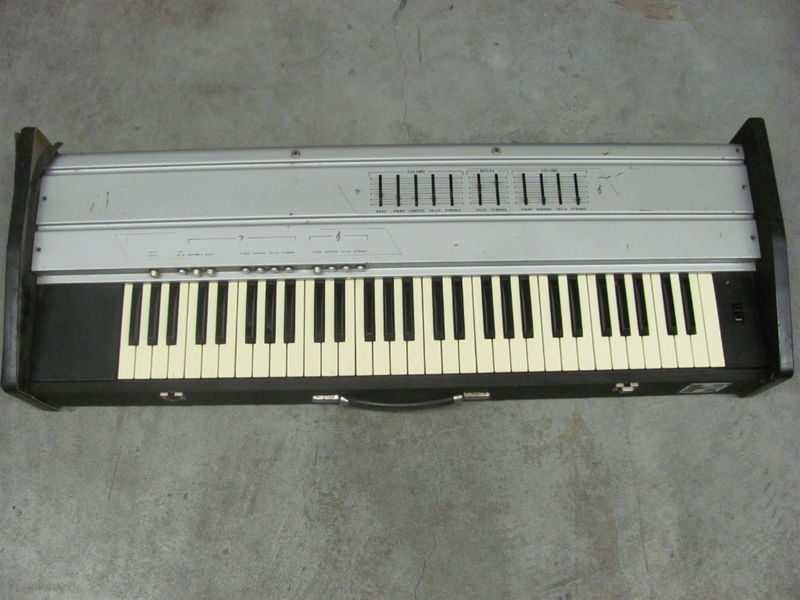
Random Thought #3 – Will We Ever Have Enough Stuff? You know, I’ve been at this music thing since the late 70s. My first professional tape recorder was a Teac A3440 4 channel reel to reel. My first keyboards were a Hohner Stringvox and a Moog Sonic Six, pictured below.

Hohner Stringvox

Moog Sonic Six

At the time, this was great stuff. Not so much anymore. And over the years, I’ve “upgraded” from this to a Yamaha DX-7 to something else better than that and on and on and on.

Today, I have no hardware gear except for my M-Audio Axiom Air 49 keyboard which controls all my “software” synths and sample players. I have the best sounding stuff on the planet all packed in the space of my PC. I never imagined this day coming back in 1979. The Teach A3440, which eventually gave way to a Boss 8 channel digital recorder is gone, along with the Boss. Studio monitors now occupy the space that my hard wired studio used to occupy.

So is this finally it? Have I seen the end of the rat race? If history is any indicator, then the answer is no.

But what’s next? I can’t even imagine where we’re going from here.

Random Thought #4 – Have we finally exhausted musical genres? I guess this is kind of along the same train of thought as the gear issue. Years ago, we didn’t have all these different genres. Heck, at one time we didn’t have any electronic music genres at all. Everything was acoustic. And even with early electronics we didn’t have the staggering number that we have today.

So my question is this. Have we finally run out of ideas that are radical enough to warrant its own genre? Can’t we classify just about anything that we do from hereon out as an existing genre or sub genre? And if we do manage to create something radically different, will it catch on? I mean what haven’t we done?

I’m curious to see where music is headed the next 20 years or so.

Random Thought #5 – How cheap is this stuff gonna get? Think about this. When synths first came out back in the 70s, they were a fortune. Do you know what some synths went for?

For example, the Yamaha CS 80, which came out in 1976, was FIVE GRAND. Do you know what that kind of money can buy you today? It’s mind boggling what early synths cost. The software equivalents, which blow these dinosaurs away in terms of sound, are hundreds of dollars, not thousands.

So I gotta wonder. How low are prices going to go? Or are we going to go in the direction of giving more stuff for a higher price tag? I mean the stuff that some companies give away blows the doors off of old synths.

Anyway, this is the kind of stuff that randomly goes through my head and I just wanted to share some of it with you today. Perhaps I’ve given you something to think about as well.

For The Love Of Music,

Steven “Wags” Wagenheim

Filed Under: royalty free articles

Synthesizer Programming Made Easy

June 26, 2014 by wags

If you’re into music production most likely you use synthesizers for some of your sounds especially if you’re into dance or electronic music. And if you’re like me, you really don’t want to use just the presets. You’d like to program some of your own sounds. But then you dig into the architecture of the synth and your head starts spinning so fast you think it’s going to fly right off your body. Especially since each synth is different. Well, fear not. I am going to try to generically walk you through synthesizer programming in a way that will make it all very clear and easy to understand. When I’m done, you’ll be able to program just about any synthesizer in the world with very few exceptions.

Let’s start with your basic sound source, the oscillator.

Oscillator’s are what produce the different sounds that you hear from your synth. Without an oscillator, you have nothing. Oh sure, you could use some white or other colored noise source to get sound but t wouldn’t be anything useful for creating music.

Every synth has to have at least one oscillator. Some have 2 or 3. Modular synths can have an infinite number of oscillators. But you need at least one. So whatever synth you’re using, find a section that says oscillator or osc for short.

Okay, every oscillator has some kind of sound “color” in the form of waves. Common waves are sawtooth, square and pulse. These are usually marked by some kind of symbol that fairly accurately represents what the wave looks like. Some synths actually write out the name in some abbreviated fashion such as saw, sqr, etc. There is usually some kind of knob or slider to choose which wave you want the oscillator to sound when a key is pressed in your keyboard. If you fiddle around with the various waves you will notice certain characteristics in their sounds. These characteristics are, to a certain extent, a part of real world instruments. When combined in certain ways along with the other parts of the synthesizer, they can actually emulate, to some degree, the sounds of real world instruments. Please note that no synthesizer, no matter how good it is, can accurately duplicate the sound of a real world instrument unless the synth has samples built in. And even then, you’re going to get close but not exact.

When two or more oscillators are used together, they can be detuned in pitch in order to “fatten” the sound. You’ll find this detuning prevalent in a lot of synth based music. In fact, it’s very rare for synth sounds to be flat and dry. They really have very little character when programmed that way.

After you have chosen your oscillator sources, the next step in the chain is to run the sound through a filter. There are many types of filters in synths. The two most common are lowpass and highpass. Lowpass filters filter out the high frequencies and let the low ones come through. Highpass do the opposite. So if you want a real low bass sound, you would use a lowpass filter. If you wanted to recreate a cymbal or high hat effect, you would use a highpass filter.

You can set the cutoff point for each filter. This cutoff point will determine how much of the sound comes through. The higher the cutoff point (moving the cutoff slider or knob to the right) the more sound comes through.

With a filter, you also get a resonance setting with most synths. The higher the setting, the more the sound will resonate. By using the resonance setting that’s how we get those nice filter sweeps common in a lot of electronic music.

Next we have the ADSR envelope which stands for attack, decay, sustain release. This controls how quickly the oscillator sounds and how quickly or slowly the oscillator stops making sound. Short attacks are good for making bass and plucked sounds. Long attacks are good for blow like sounds or slow pads. Short decay settings are good for plucked sounds. Same with sustain. I won’t get into the differences between decay and sustain here as that’s a bit involved. Release controls how long the sound continues after the key is released. Long release settings are great for ambient pads or for simulating long reverb. In short, the ADSR envelope shapes the contour of the sound.

Now, these envelopes, in some synths, can be used to also control how quickly or slowly the filter reacts to the sound. It can slow down the attack of cutoff if it’s being modulated. It can slowly raise the resonance point. Most synths comes with an ADSR 1 and 2. The first one is usually assigned to the oscillator while the second one is assigned to the filter. By combining these, we can get some very interesting sounds that aren’t static.

Finally, we have the LFO section which stands for low frequency oscillator. The LFO is like an oscillator but it doesn’t make any sound by itself because it works on too low a frequency to be heard by the human ear. Like the sound oscillator, it also has waves. The most common on sine and square. The sine wave, when used to modulate the sound oscillator, produces things like vibrato. When controlled by the mod wheel, it can bring the vibrato in and out. Most LFOs will have a setting where you choose what source controls it, such as your mod wheel.

What I have described above is a very basic synthesizer. However, even the most complex synthesizers are made up of these basic components. For example, a modular synthesizer is just lots of different modules that you can put together that essentially all contain oscillators, filters, ADSRs and LFOs. You can then combine these in some very interesting ways. If you want to experiment with this, pick up Sonigen Modular. It’s free.

Synthesizer programming is not hard. But it does take time to get familiar with all the working parts. But if you take them one at a time and understand that you need an oscillator first in order to get a sound, you won’t be sitting there hitting keys and getting no sound from your synth. Once you can get a sound, experiment. You can’t break anything. By letting your mind go free, you may find that you come up with some very interesting sounds.

Happy programming.

For The Love Of Music,

Steven “Wags” Wagenheim

Filed Under: royalty free articles

Getting The Most Bang For Your Buck

June 25, 2014 by wags

It’s a fact that not all of us are made out of money. These days, I’m certainly not. Unfortunately, when you have a job to do, sometimes you need to bite the bullet and spend some cash in order to get the hardware and software that you need. So what do you do when you’re strapped for cash but need to put together a music production studio? Well, I’m going to offer a few suggestions on how to get the most bang for your buck out of whatever it is you need.

Let’s start with your PC. Oh please, you’re not going to try to produce music on that slow, barely enough room to fit Minesweeper, archaic contraption are you? Look, I had a perfectly fine working computer when I got into the music business. But I knew darn well that there was no way I was going to produce music on it unless I was willing to sit around for an hour waiting for a 3 minute track to process.

So what do you do when you need a PC but don’t have the bucks to get a really good one? Simple, you buy one second hand. Trust me, there are plenty of super fast PCs with more than enough memory and hard drive space out there for sale for a variety of reasons ranging from “I don’t need a computer anymore” to “I need something even more powerful” because let’s face it, fast and big is never fast and big enough. Point is, there will be a PC out there that is more than capable of doing music production that you’ll be able to pick up for $300. If the hard drive is old, most likely you’ll have to replace it in a couple of years. But until then, you can get up and running and make enough money to pay for a new hard drive or even a new PC if you want. But get up and running first. No computer means no income.

What about the software? Well, for starters you’re going to need a digital audio workstation or DAW for short. Don’t have $300 to shell out for Cubase or Pro Tools? Get Reaper. No, it’s not free but the demo version never expires so you can use it forever without having to pay for it. Not sure why they allow this but whatever. And there are other free DAWs that can do a basic job for you. No need to shell out big bucks for production software.

Okay, now we get down to the stuff that actually makes the music? I’m talking about VSTs. Now, if you’ve read some of my earlier articles, you’ve heard me go on and on about Komplete 9 and East West Quantum Leap products. They’re quite pricey. But you don’t need this top of the line stuff to make music. I have to have over a hundred VSTs that are free and I’m going to share some of the best ones with you here.

Synth1 – If you want to make fat analog sounding synth tracks, this one VST can do it all. You can literally build an entire song out of multiple instances of this in your DAW, especially if you’re doing dance or electronic music. There are user libraries that you can download with thousands of patches so you never have to program a thing. Just pick the sound you want and play. This beast is absolutely free AND it works on 32 bit and 64 bit Windows 7. You shouldn’t have any trouble with it.

DrumMica – Need acoustic drums. This should do nicely. The registration process is a bit of a pain and it’s a beast to download at 4.7 gig, but I think you’ll find it’s worth the time and effort. You will also need to download the free Kontakt player from Native instruments in order to use this as that’s the engine it uses. Free synth drums are a dime a dozen and can be found just about anywhere. But acoustic drums, not so easy. Most are not free. In fact, this is the only one I’ve found that is. Oh, the site is German so you’ll have to translate to English if you want to be able to actually read it. Google Chrome does this pretty well.

Revitar – Until I found the AAS Strum series, this was the best strumming guitar VST I had ever seen. It’s still just as good as it was before I found AAS. The sound is crisp and clean for both the acoustic and electric guitars. If you want processing, you’re going to have to get your own external processors such as reverb, distortion, chorus, delay, etc. This is just a bare bones guitar strummer. If that’s what you need, this delivers very well and it’s free.

Sonigen Modular – Want a powerful modular synth that can do just about anything? This beast is free. The learning curve is a bit steep. If you’ve never programmed a modular synth before this will take you some time to get used to. But it’s worth the effort. The sound is fat and big and may be the only synth that you’ll ever need for all around work.

And the above free products only scratch the surface as far as what’s out there. There are tons of free effects processors such as Limiter6 which is a more than capable limiter to make sure your tracks don’t go into the red. It can also do plain compression as well.

Sure, you’re going to have to hunt for some of the stuff you need but finding it is pretty easy. Just go to your favorite search engine and type “free —-” and whatever it is you’re looking for. Trust me, it exists. Some solutions are better than others. Some will only work on certain platforms, like Windows or Mac. But if it’s something that is fairly commonly used, you can almost bet that it’ll be out there.

So you see, it IS possible to put together a music production studio on a shoestring budget.

For The Love Of Music,

Steven “Wags” Wagenheim

Filed Under: royalty free articles

My Thoughts On East West Quantum Leap Products

June 24, 2014 by wags

In a recent article, I gave my opinion about Native Instruments Komplete 9 package. In this article I’m going to share my thoughts on the suite of products offered by East West Quantum Leap. While these can be purchased together in the Complete Composers Collection, they are, for the most part, all separate products and can be purchased individually just as the products in Komplete 9 can be as well.

As is true of the Native Instruments suite of products, EWQL has just about everything covered. But their real specialty, in my opinion, is the orchestral stuff. You would be hard pressed to find better. So let’s start there.

You have individual products and various grades for each product ranging from Silver to Gold to Platinum to Diamond. Yeah, it gets a little crazy and personally, I think this is a money making scheme. Yes, there is a difference between each package but I’m not sure those differences warrant four different products for each one. I think two would have been sufficient. But hey, it’s business and I guess they know what they’re doing. Anyway, that’s my only complaint about their products. The Native Instruments products don’t mess around with that nonsense.

But what about the sounds? I guess that’s what’s really important in the grand scheme of things? Well, if you want what I would call passable sounds for your orchestral scores, you want to at least go with their gold packages. The Silver just don’t cut it as far as articulations go. The biggest difference between gold and platinum are the mic positions. You don’t get the full suite with the gold packages and that is a bit of a problem if you need the close mic position. If not, you’ll be fine.

East West gives you the following main packages

Hollywood Strings
Hollywood Brass
Hollywood Orchestral Woodwinds
Symphonic Orchestra
Symphonic Choirs

Of the five packages, the oldest is the symphonic orchestra package. The string, brass and woodwind sounds are not as good quality wise as the Hollywood packages. But it’s an inexpensive solution to getting everything. Plus, it comes with percussion and cymbals that you can’t get anywhere else. So if you need things like Timpani, Cymbals and even a harp, then this package is a must have. The sounds are more than the serviceable if not top notch.

As far as the Hollywood sounds, they are all excellent. The Brass and Strings I feel are a notch above the woodwinds but not by much. The articulations that comes with these sounds are staggering in number. And that may be one of the few “problems” with these packages.

Let me explain.

If you’re not familiar with the various play styles of each instrument, especially the strings, you will have a difficult time picking the proper articulation for your project. Some of them have very subtle differences.

For example, let’s take the Hollywood Strings package.

You have 3 different articulations for the basic strings. They are all different round robins. The first one is NV, NV, NV, VB where NV stands for non vibrato and VB stands for vibrato. The second one is NV, NV, VB, VB. The third one is NV, NV, VB, MV where MV stands for molto vibrato. The differences between these three patches are subtle but noticeable.

And then of course you have Marcato, Pizzicato, Staccato, and so on. A solid knowledge of scoring for strings will help a lot if you’re going to, first of all, pick the right articulation and ultimately make the best use of it.

In short, if you take the time to really go through the package and play with all the articulations, you’ll get a pretty good feel for how to use them in a production. The realism, when used correctly, is scary good.

And this carries over to the brass and woodwinds as well. All these packages really capture the sound of a symphonic orchestra.

Obviously, a package this in depth is going to have a huge learning curve, and it does. So if you’re looking for something that you can just take out of the box and start playing with, you probably want to look elsewhere unless true realism isn’t what you’re after. Yes, the sounds are great. But it’s how you use them that really determine whether or not your music is going to sound like a real symphony orchestra. That just doesn’t happen out of the box and not without some degree of scoring chops.

As for the other EWQL products, they are a lot more forgiving.

If you’re looking for an all around package to cover the full range of musical genres, then you will want to pick up Goliath. While this doesn’t specialize in any one area, it does contain sounds for rock, pop, orchestral and even world music. It comes with a pretty decent grand piano too. If money is tight and you need to cover multiple genres, pick up Goliath. You won’t be sorry. The sounds are good. Not off the charts great like the Hollywood series, but good. With some processing and good composition skills, this package can pull off some great sounding demos and even finished products.

If world music is high on your priority list, you will want to pick up the RA and Silk packages. They have a number of regions covered especially China and India. The sounds are crystal clear and very authentic sounding. These instruments are recorded with the same great technology that the Hollywood series is recorded with. Yes, all instruments are real samples. There are no synthesized sounds. Even the synth sounds of Goliath are sampled from the actual real synthesizers.

For some killer hard rock and even pop rock sounds, there is Ministry Of Rock 2, which is essentially bass, drums and guitars. These all sound amazing.

If you need some good sounding pianos, the Pianos package is good. Not great, but good. I think the pianos are a little dead sounding compared to some other pianos. But with a little EQ and processing they sound much better. If you get Goliath, it’s probably the one package you can do without.

You absolutely want to check out the Symphonic Choirs if you need choir background vocals. I could write a whole article on this package alone. It needs to be heard to be believed. Yes, it’s that good. And the Word Builder puts it over the top.

Finally, Voices Of Passion is a neat little package with vocals from around the world. It’s really kind of a niche thing and you probably won’t use it as much as the other packages. But if you need the effects, it’s worth the price.

It goes without saying that all of the above products take some study to use to their potential. But I can’t say enough about them. I’d be totally lost without these VSTs. I use them for all my orchestral and classical stuff and even some rock. Oh, by the way, if you want to recreate the Beatles sounds of the 60s, get their Fab Four package. It’s probably the most fun to use of all of them.

Bottom line: This is great stuff. You won’t be sorry. I recommend getting the Complete Composers Collection. That way you save a crap ton of money buying all these things separately.

Well worth every penny.

For The Love Of Music,

Steven “Wags” Wagenheim

Filed Under: royalty free articles

« Previous Page
Next Page »

Copyright © 2025 · Optimal on Genesis Framework · WordPress · Log in